
Franchise Buyer Persona: Home-Based, Low-Cost Lifestyle Seeker
This article is part of a comprehensive series examining the 15 franchise buyer personas shaping today’s franchise landscape. Each persona represents a distinct segment of candidates defined by their background, motivations, and decision-making behaviors. Understanding these nuances helps franchise brands attract, engage, and support the right owners for their system.
In this piece, we take a deep dive into the Home-Based, Low-Cost Lifestyle seeker. This buyer is drawn to franchising as a path to income replacement and flexibility without the burden of high fixed costs or complex operations. They want a business that fits into their life, not a life that must bend to the demands of a traditional brick-and-mortar operation.
Here we explore the defining characteristics, motivations, pain points, and franchise preferences of this persona. We examine how they evaluate investment timelines, capital requirements, and risk. We also look at what they expect from a franchise system in terms of support and transparency. Finally, we outline actionable marketing strategies and messaging approaches that help franchisors connect with and convert these cautious yet highly motivated lifestyle-driven buyers.
What Is the Demographic Profile of the Home-Based, Low-Cost Lifestyle Seeker?
Members of this franchise buyer persona are often motivated by the desire for greater control over their time, income, and professional direction while minimizing financial risk. As traditional employment becomes less predictable and flexible work models gain appeal, many prospective franchise owners are exploring business models that allow them to operate from home, keep startup costs manageable, and build a sustainable income around their personal and family priorities.
The demographics below highlight the common life stages, professional backgrounds, geographic patterns, and financial realities that shape this growing group of franchise candidates.
Age and life stage:
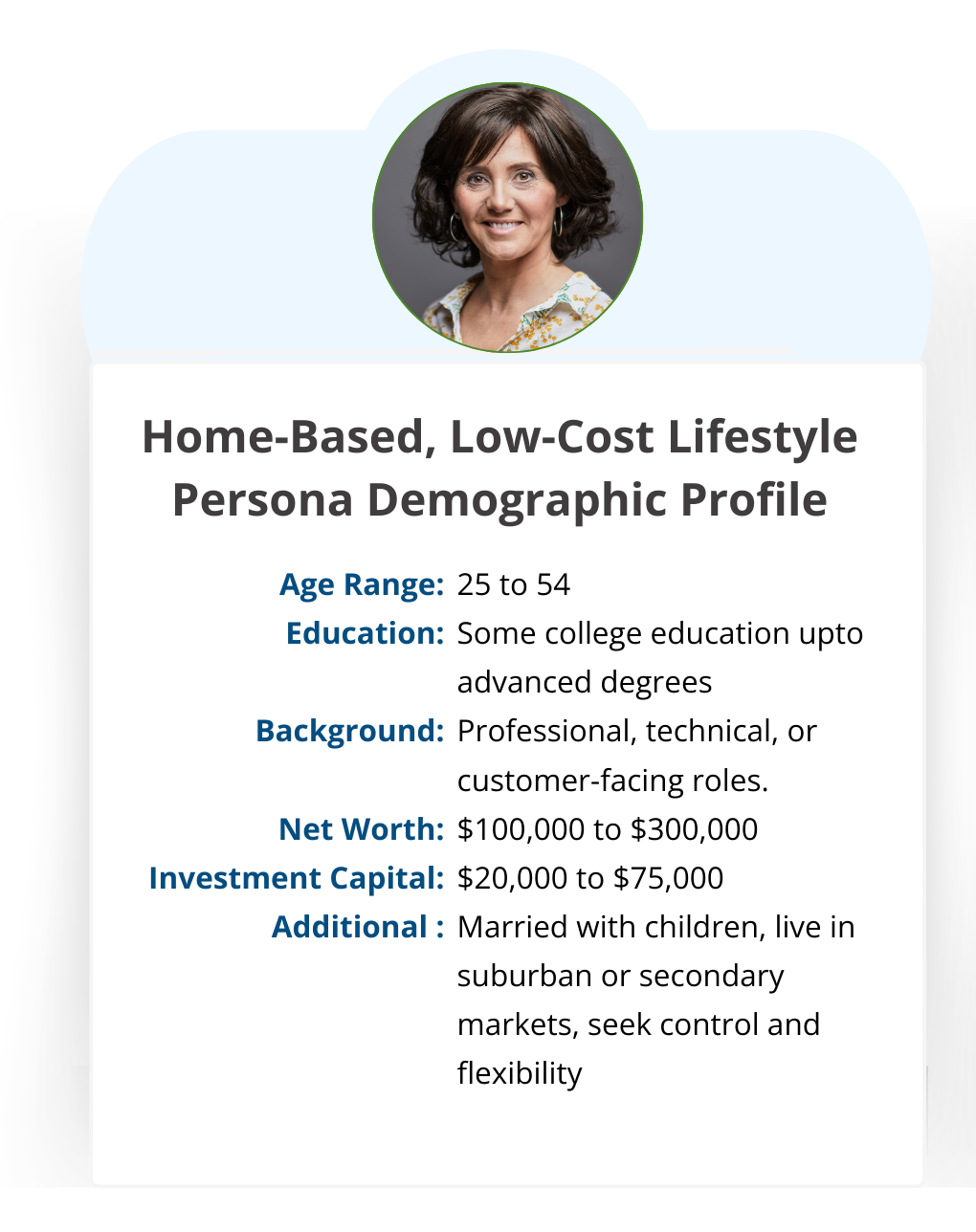
Common age groups are 25–34 and 35–54, both showing strong interest in low-cost, lower-risk franchise models.
Many are in family-building or peak earning years, which heightens their sensitivity to risk and income disruption.
Education and background:
Most have at least some college education, with many holding bachelor’s degrees and some with advanced or technical credentials.
Their experience often spans professional, technical, or customer-facing roles that build communication and service skills.
Professional history:
Many come from corporate or office-based roles and are experiencing burnout, layoffs, restructuring, or stalled advancement.
Others come from sales, service, or operations roles where they are comfortable working directly with customers.
Some have experimented with side hustles or gig work and now want a more structured, brand-backed opportunity.
Family and geography:
Many are managing family responsibilities and seek schedule control, flexibility, and proximity to home.
Home-based, low-cost lifestyle seekers often live in suburban or secondary markets where home-based operations are practical and commercial real estate costs are a concern.
Financial profile:
Home-based, low-cost lifestyle seekers are attracted to franchises with total upfront investments under about $55,000 for home-based concepts.
Many target low-cost franchises that can be launched in the $10,000–$100,000 total investment range, including fees and working capital.
Liquid capital commonly sits in the $20,000–$75,000 range, with additional access from savings, retirement funds, or home equity if comfort level allows.
Psychographically, the home-based, low-cost lifestyle seeker is pragmatic, risk-aware, and lifestyle-focused. They want to reduce dependence on a single employer while avoiding the stress and exposure of a large, fixed-cost business.
What Motivates the Home-Based Lifestyle Seeker to Buy a Franchise?
Motivations for this persona center on lifestyle design, autonomy, and careful risk management rather than aggressive empire building. They want more control over how they spend their time and how they earn income, but they are not willing to gamble on untested concepts or high overhead.
Key motivators for the home-based, low-cost lifestyle seeker include:
Schedule control and flexibility. They value the ability to work from home or locally without being tied to a physical storefront or rigid hours.
Lower barrier to entry. Low initial investment and reduced ongoing overhead make home-based franchises feel more attainable and less risky than brick-and-mortar models.
Income replacement and stability. Many want to replace or supplement an existing salary without taking on a large lease, heavy payroll, or inventory obligations.
Ownership with support. They want to build something of their own, but with a proven system, defined playbook, and ongoing guidance from the franchisor.
Personal alignment. They look for concepts that align with their interests, skills, or values, especially in service-oriented or home-based categories.
For lifestyle seekers, success often means predictable income, time freedom, and reduced stress. It is less about scaling rapidly into multi-unit ownership and more about building a stable, flexible business that supports their preferred way of living.
What Kinds of Franchises Draw the Home-Based, Low-Cost Lifestyle Seeker?
This persona gravitates toward models with low fixed costs, flexible operations, and modest staffing needs. They want a business that feels manageable and does not require extensive buildout, complex equipment, or heavy payroll.
Commonly preferred categories include:
Home-based service franchises. Examples include home services, inspections, coaching, consulting, and various mobile service businesses that run from a home office.
Lifestyle-aligned concepts. These include travel planning, education and tutoring, kids’ activities, and specialty services that can be coordinated from home.
Mobile and territory-based brands. These models allow owners to operate from home while serving a defined local territory using a vehicle, small equipment set, or portable setup.
The Home-based, low-cost lifestyle seekers is likely to avoid capital-intensive food, retail, and fitness concepts. The high rent, construction, inventory, and staffing needs make these categories less attractive given their risk profile and lifestyle goals.
Across categories, the strongest fit for this persona is a franchise that offers clear systems, predictable operating rhythms, and the option to remain lean and home-based while still allowing room for growth.
What Financial Concerns and Constraints Shape Their Decisions?
Financial anxiety is central for the home-based, low-cost lifestyle seeker and often delays or prevents investment. They approach franchising with caution, aware that missteps can have lasting consequences for their savings and family stability.
Common financial concerns for this group include:
Underestimating working capital. Many underestimate what is required to cover both business costs and personal living expenses during ramp-up.
Fear of overleveraging. They worry about taking on too much debt, using high-interest credit, or relying on “high-pressure capital” that increases stress.
Strain on savings or retirement. Even low-cost franchises can feel risky if the investment draws heavily on savings or retirement funds.
Income variability. They are concerned about how long it will take to reach stable, predictable income that can reliably replace or supplement a paycheck.
Personal guarantees and collateral. Using home equity or pledging personal assets makes them especially cautious.
Several factors can prevent prospective buyers from moving forward with an investment. Many are unable to meet liquid capital and reserve requirements without creating significant financial strain. Others hesitate due to a lack of clear visibility into realistic earnings potential, the expected time to break even, and possible downside scenarios.
Additionally, fear of losing capital that may have taken many years to accumulate can be a major barrier, particularly for first-time business owners and individuals with family obligations who must carefully weigh financial risk.
For franchisors, transparent, conservative financial framing is critical. This persona responds to realistic ranges and clear explanations, not aggressive projections or vague promises.
What Pain Points Does This Persona Face When Pursuing Franchise Ownership?
The home-based, low-cost lifestyle seeker faces a mix of financial, informational, and emotional challenges. These pain points influence both their research process and their interactions with franchise brands. Key pain points for this group include:
Information overload. The low-cost franchise space is crowded, with many brands making similar claims. It can be hard to distinguish truly viable concepts from marketing noise.
Limited ownership experience. Many have never owned a business before and find due diligence, FDD review, and risk evaluation intimidating.
Hype versus reality. They struggle to separate realistic earnings and timelines from optimistic marketing, particularly in online listings and portals.
Balancing family and launch. Launching a business from home while managing household and caregiving responsibilities raises concern about burnout and blurred boundaries.
Fear of making the wrong choice. The risk of choosing a misaligned concept that costs money and time is especially concerning for mid-career buyers.
Isolation. The prospect of running a solo, home-based operation raises fears of feeling isolated without a built-in team or peer network.
These pain points create a strong need for structured guidance, peer connection, and honest, detailed information about what daily operations and ramp-up really look like.
How Do Home-Based Lifestyle Seekers Make Investment Decisions?
This persona tends to follow a deliberate, research-heavy decision process. They move more slowly than impulse-driven buyers, but they are thorough and intentional once they commit. Most home-based, low-cost lifestyle seekers will follow this typical decision timeline:
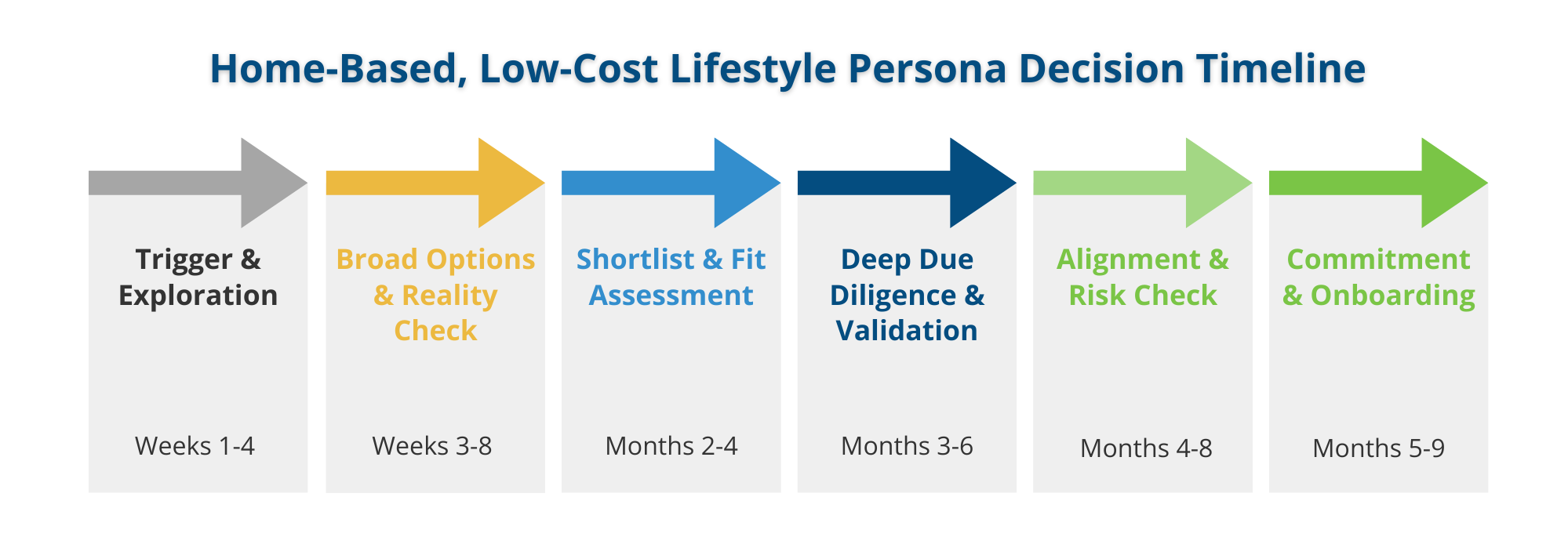
Initial research phase. They browse low-cost and home-based categories, read articles, explore portals, and compare multiple brands over several weeks or months.
Evaluation phase. They narrow down to a short list, engage with development teams, review FDDs, speak with franchisees, and review funding options. This stage often adds a few more months.
Overall timeline. From first serious research to signing, a realistic range is often in the 3–9 month window for cautious lifestyle-focused buyers, depending on capital readiness and personal confidence.
Decisions often stall at a few key points during the evaluation process. One common barrier is funding uncertainty, where progress slows or stops if a candidate’s capital plan is unclear, incomplete, or still being explored.
Another frequent point of hesitation occurs when there is misalignment with lifestyle expectations. If the day-to-day operational realities of the business appear inconsistent with the flexibility, schedule control, or lifestyle the candidate envisioned, they may pause their decision or return to exploring other opportunities.
Brands that provide structured education, transparent financial guidance, and consistent follow-up are more likely to keep this persona engaged throughout the full decision cycle.
What Messaging and Content Resonate Most with This Persona?
The home-based, low-cost lifestyle seeker responds to content that blends realistic numbers with clear lifestyle benefits. They want to see how the model works in practice and how it can support the life they want.
Content and angles that perform well with this persona include:
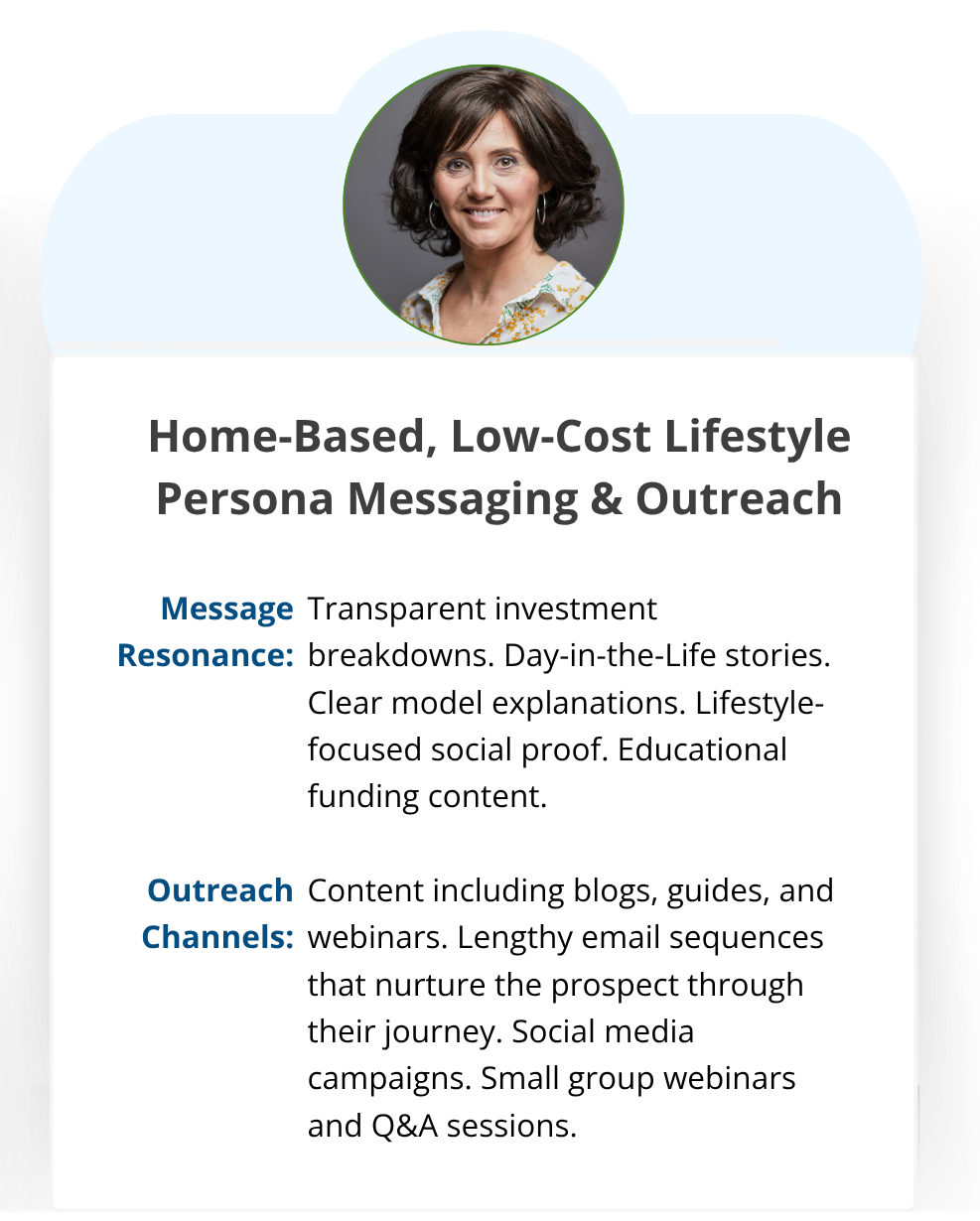
Transparent investment breakdowns. Clear explanations of total investment, working capital, and typical time to stable income, framed conservatively, build trust.
Day-in-the-life stories. Case studies and narratives featuring owners running the business from home while balancing family and personal priorities help prospects visualize themselves in the role.
Simple model explanations. Straightforward breakdowns of how the business makes money, what drives revenue, and any seasonality help demystify operations.
Lifestyle-focused social proof. Testimonials and reviews that emphasize low overhead, manageable ramp-up, and quality of life resonate more than high-growth, multi-unit stories.
Educational funding content. Guides on funding options, capital planning, and risk management for first-time buyers directly address core concerns.
The tone and format preferences for the home-based, low-cost lifestyle buyer tend to reflect a practical, research-oriented mindset. They respond best to straightforward, no-hype communication that acknowledges their sensitivity to financial risk and supports their analytical decision-making process.
Educational content formats are especially effective when they can be reviewed independently, such as short videos, checklists, and step-by-step guides that simplify complex information. They also value practical tools, including simple calculators, sample budgets, and scenario illustrations, that help them clearly visualize cash flow, startup costs, and capital requirements.
The most effective messages reinforce that the franchise is both lifestyle-friendly and financially grounded, with no hidden surprises.
How Should Franchisors Market to and Attract the Home-Based, Low-Cost Lifestyle Seeker?
Effective marketing to this persona relies on education, transparency, and low-pressure engagement. The goal is to guide them through a complex decision rather than push them into a quick close.
Marketing strategies that are high-impact and most likely to engage this persona include:
Content marketing. Publish blogs, guides, and webinars about low-cost franchising, funding strategies, and home-based lifestyle outcomes, optimized for search queries related to low investment and home-based franchises.
Nurture sequences. Develop email flows that answer questions over time about capital, support, ramp-up, and daily operations instead of pushing immediate sales calls.
Social channels and communities. Use targeted social media campaigns and organic content to highlight real owner stories and flexible lifestyle outcomes.
Portals and directories. Maintain a strong presence on low-cost and home-based franchise portals, where these buyers often start their research.
Low-pressure discovery events. Offer small group webinars and Q&A sessions that allow prospects to learn, ask questions, and hear from franchisees without high-pressure tactics.
With this persona, trust is built through transparency, access, and a process that respects the prospect’s decision timeline. Prospective buyers place significant value on easy access to existing franchisees, allowing them to hear firsthand about ramp-up experiences, the level of franchisor support, and what the day-to-day lifestyle actually looks like. This peer validation helps reduce uncertainty and build confidence in the opportunity.
In addition, clear next steps and realistic timelines help prospects move through the evaluation process at a comfortable pace, reinforcing trust by avoiding artificial urgency or high-pressure sales tactics.
When done well, marketing to this persona positions the brand as a helpful guide that understands their constraints and aspirations, not just a seller of opportunities.
What Solutions Help Overcome Doubts and Move This Persona Forward?
For the home-based, low-cost lifestyle franchise seeker, interest alone rarely leads to a purchase decision. This group evaluates opportunities cautiously and tends to progress only when a brand clearly reduces both financial uncertainty and operational ambiguity.
To convert curiosity into commitment, franchisors must provide practical guidance, transparency, and evidence that the opportunity can be pursued responsibly. The following elements consistently help remove barriers and build the confidence needed to move forward:
Clear capital guidance. Provide specific ranges for total investment, working capital, and personal reserves, along with practical examples that illustrate real scenarios rather than theoretical minimums.
Funding education and resources. Offer clear education on funding options and introduce lenders familiar with your brand so candidates can structure financing responsibly.
Strong onboarding and training. Explain how training, launch support, marketing assistance, and ongoing coaching work, with particular attention to first-time owners and home-based operators.
Validated owner stories. Share case studies of owners who started with modest capital and achieved stable, lifestyle-aligned outcomes over realistic timeframes.
Expectation setting. Discuss ramp-up timelines, workload, and average performance openly so candidates understand the typical experience rather than comparing themselves only to top performers.
When an opportunity is framed as a structured, supported path to business ownership with manageable overhead, transparent financial expectations, and realistic timelines, this persona is far more likely to transition from casual research to serious engagement.
Final Thoughts
The Home-Based, Low-Cost Lifestyle Seeker represents one of the most practical and steadily growing segments within the modern franchise market. These buyers are not chasing rapid expansion or high-risk opportunities. Instead, they are searching for a stable, manageable path to business ownership that offers income potential while preserving the flexibility and control they want in their lives.
Because of their cautious and research-driven approach, this persona requires franchisors to lead with clarity, transparency, and education. To remove much of the uncertainty that slows this group’s decision-making, brands should openly address:
Capital requirements
Realistic ramp-up timelines
Operational expectations
Lifestyle implications
At the same time, providing access to existing franchisees, practical financial guidance, and structured onboarding reinforces the sense that the opportunity is both achievable and responsibly designed.
For franchise systems willing to meet these expectations, the reward is significant. Home-based, low-cost lifestyle seekers may move carefully, but they often become thoughtful, disciplined operators who value the structure and support of a franchise system. By aligning the opportunity with their financial realities and lifestyle priorities, franchisors can attract owners who are motivated to build steady, sustainable businesses that strengthen the brand over the long term.
For more information on the 15 franchise buyer personas and to review the previous persona profile reviews, visit the Franchise Education Center.
